Quality Score is Google’s 1–10 rating of your ads against other advertisers on the same search. There is no official pass mark: what matters is the three parts behind it (expected click-through rate, ad relevance and landing page experience). If none is rated Below average, the score is doing its job. Fix the part that is low, not the number.
Open the keywords report in a tradie’s Google Ads account and you will often find a column of numbers from 1 to 10 that nobody has looked at. That is Quality Score. It does not set what you pay, but it tells you why you might be paying more than you need to. This article explains what the number means, what a good one looks like for a trade business, and what to change when it is low. For what clicks cost in the first place, see how much Google Ads cost in Australia.
What Quality Score actually is
Google describes Quality Score as a diagnostic tool “meant to give you a sense of how well your ad quality compares to other advertisers”. It is shown for each keyword on a scale of 1 to 10, and it is worked out by comparing your ads with other advertisers whose ads showed for the exact same search over the last 90 days.
Two things follow from that. First, it is relative: a 6 means you are behind the other plumbers, electricians or roofers bidding on that search, not that you failed a fixed test. Second, it is backward-looking and built on exact searches of the keyword, so a new keyword or a low-volume suburb term may show a dash instead of a number. Google says that dash means there are not enough searches that exactly match the keyword to calculate a score.
The three parts behind the number
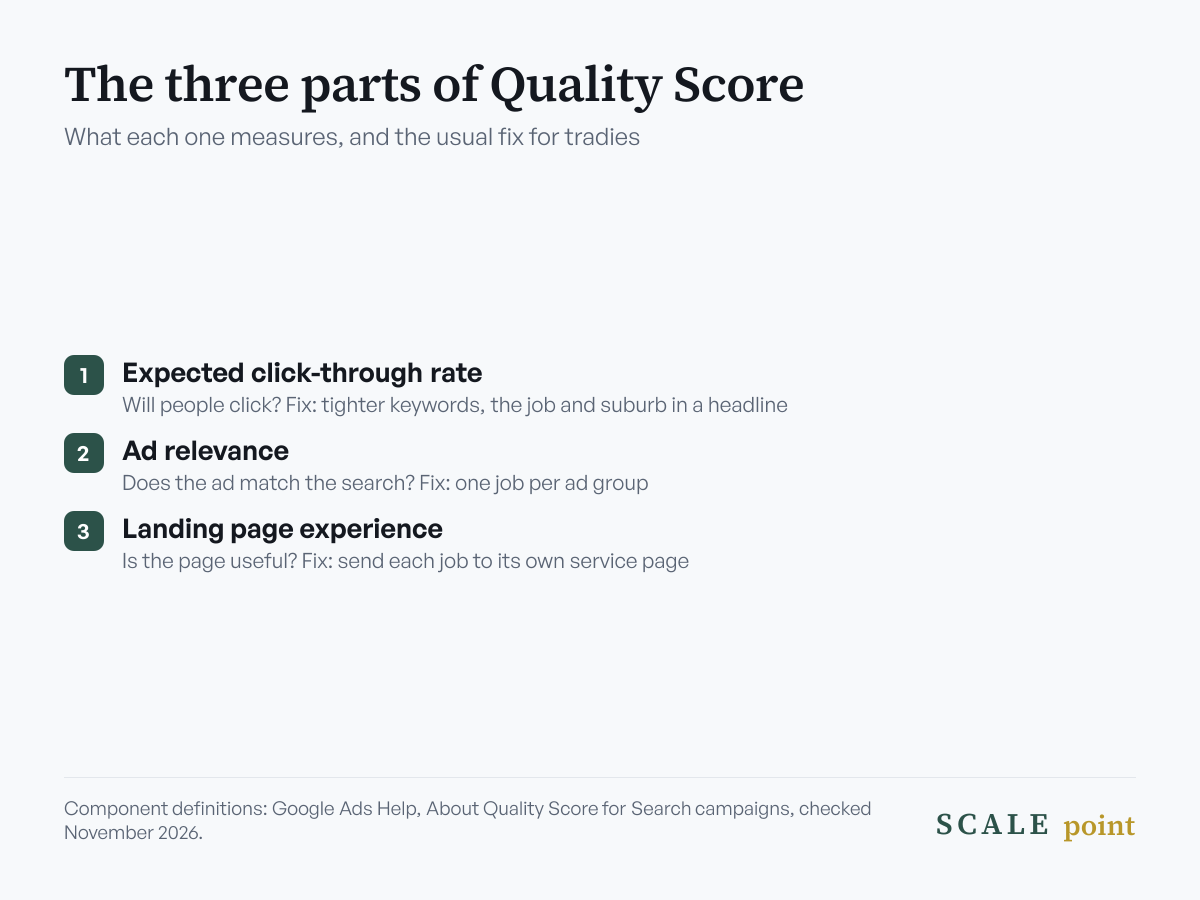
The 1–10 score summarises three ratings. Each one is marked Above average, Average or Below average, and these ratings are more useful than the number itself because they tell you what to fix.
| Part | Google’s definition | What it usually means for a tradie |
|---|---|---|
| Expected click-through rate | The likelihood that your ad will be clicked when shown | Your ad shows for searches it does not fit, or the headline does not repeat the job and area |
| Ad relevance | How closely your ad matches the intent behind a user’s search | One ad is trying to cover drains, hot water and leaks at once |
| Landing page experience | How relevant and useful your landing page is to people who click your ad | Clicks go to the home page, or the page does not mention the job, the area or how to book |
So what is a good Quality Score?
Google does not publish a target number. Its guidance is that only Average or Below average ratings may indicate an opportunity to make improvements. So the honest answer is: a good Quality Score is one where none of the three parts is Below average on the keywords that bring you work.
As a working rule (our rule of thumb, not a Google standard), we read the scores on a tradie account like this:
- 7 to 10: healthy. Leave it alone and spend your time on tracking, bids and the landing page’s conversion rate.
- 5 or 6: one part is usually Average or Below average. Check which one, and fix it if the keyword spends real money.
- 1 to 4: something is mismatched. Typically the keyword does not belong in that ad group, or the ad sends people to a page about something else.
- A dash: not enough exact searches yet. Common for suburb-level keywords. Judge those by cost per enquiry instead.
Only chase Quality Score on keywords that spend. A 3 on a keyword that spent nothing last month costs you nothing. A 5 on your main “emergency plumber” keyword is worth an afternoon.
Why it matters for your cost per click
Google is clear that Quality Score is not an input in the ad auction. What the auction uses is Ad Rank, which Google says is based on six factors, including your bid and the quality of your ads and landing page at the time of the search. Quality Score is a summary of how that quality has looked on average.
That is why it still matters. On the Ad Rank page Google states that higher quality ads can often lead to lower costs per click. Better ads and landing pages can win the same position for less, or a better position for the same bid. Quality Score is the gauge that tells you whether that is happening.
How tradies fix a low Quality Score
Expected click-through rate is Below average
- Check the search terms report and add negative keywords for searches you do not want, such as DIY, jobs, courses and free.
- Put the job and the suburb or region in a headline, with the keyword whole in one line. Our guide to writing Google Ads copy for tradies covers what to write in each headline.
- Add sitelinks, callouts and a call asset so the ad takes more space and gives a reason to choose you.
Ad relevance is Below average
- Split mixed ad groups so each one holds a single job, such as blocked drains, hot water or gas fitting.
- Rewrite the ad for that job only. If a keyword still does not fit any ad, it probably should not be in the account.
Landing page experience is Below average
- Send each ad group to the page for that job, not the home page. If the page does not exist, build it: a service page is also an SEO asset.
- Make the page answer the ad: the same job, the area you cover, how pricing works, and a phone number and form above the fold on mobile.
- Make it fast on a phone. A slow page loses the click you already paid for.
What not to do
- Do not raise bids to fix Quality Score. A higher bid can lift Ad Rank, but it does nothing for the score and costs you more per click.
- Do not pause good keywords because the number is low. If a keyword books jobs at a cost per lead you are happy with, keep it and improve the ad and page around it.
- Do not judge a new account on Quality Score in the first weeks. The score needs search history, and early numbers move a lot.
- Do not treat a 10 as the goal. A keyword can score 10 and still bring the wrong jobs. Judge the account on cost per lead and booked work, which needs conversion tracking in place.
Having your Quality Score looked after
Scalepoint’s Google Ads management is A$990/month + ad spend, ex GST. It covers the ad group structure, ad copy, landing page advice, negative keywords and the ongoing checks described here. The account stays in your name, ad spend is billed by Google at cost with no markup, and it runs month-to-month. All prices are on the pricing page.
Sources
- About Quality Score for Search campaigns, Google Ads Help.
- About Ad Rank, Google Ads Help.
Quality Score is a 1–10 diagnostic that compares your ads with other advertisers on the same search. Google sets no target number; the useful signal is whether expected click-through rate, ad relevance or landing page experience is Below average. Fix that part on the keywords that spend, and judge the account on cost per lead and booked jobs.
Found this useful? Make Scalepoint a preferred source in Google Search.