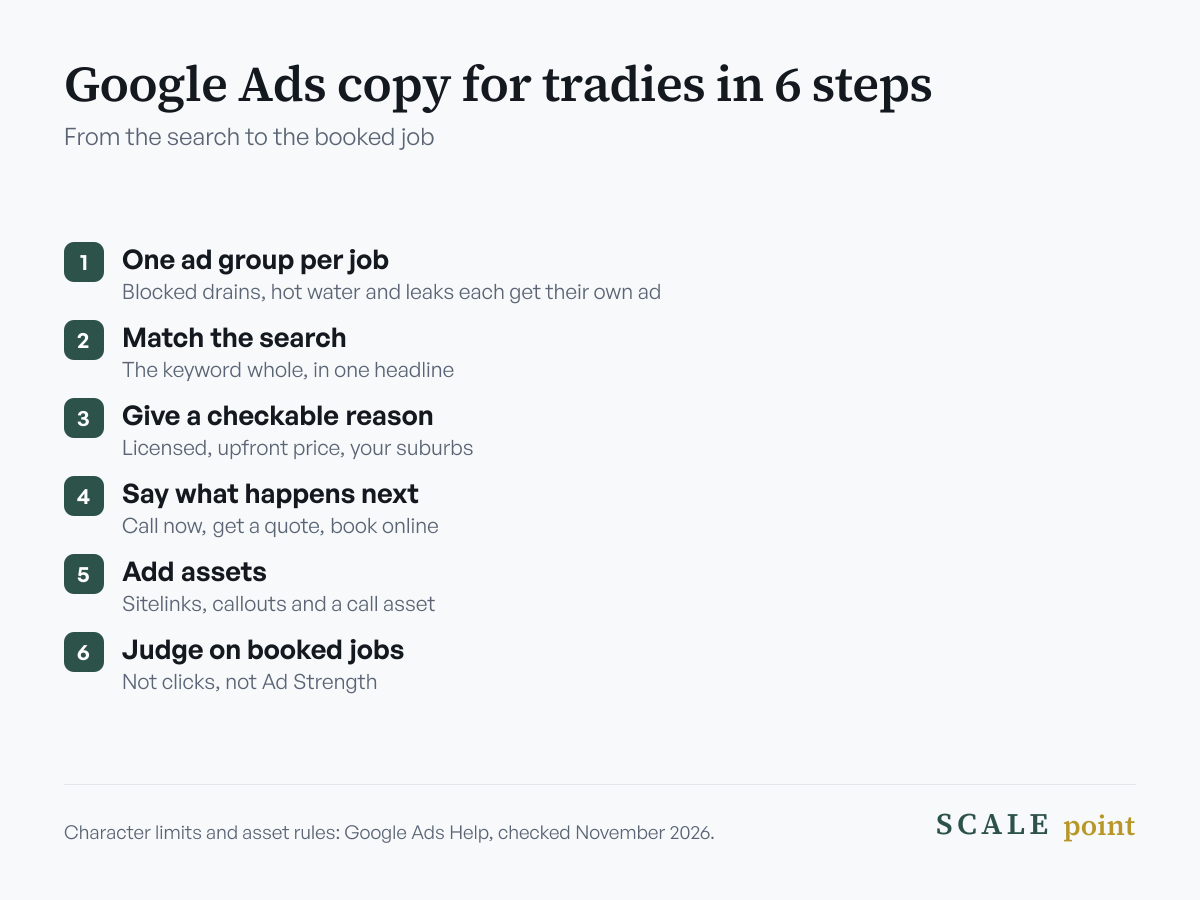
Good Google Ads copy for tradies does three jobs: it repeats the search (the job and the suburb), gives a checkable reason to call you, and says what happens next. A responsive search ad takes up to 15 headlines of 30 characters and 4 descriptions of 90, so write each one to stand alone, then judge the ad on booked jobs, not clicks.
Most tradie Google Ads lose money before anyone reads them: the wrong searches, no tracking, a landing page that does not answer the question. Once those are right, the copy decides whether the person who searched “blocked drain Northcote” calls you or the ad above you. This guide covers how Google builds the ad, what to write in each slot, and how to tell whether it worked. For what clicks cost, see how much Google Ads cost in Australia.
How a Google search ad is put together
Search ads are now responsive search ads. You write a set of headlines and descriptions, and Google assembles combinations of them for each search and tests which do best. That changes how you write: any headline can sit next to any other, so each one has to make sense on its own.
| Part | How many | Characters each |
|---|---|---|
| Headlines | At least 3, up to 15 | 30 |
| Descriptions | At least 2, up to 4 | 90 |
| Display path (the words after your domain) | Up to 2 | 15 |
| Sitelink text | At least 2 to show; Google suggests 6 or more on busy campaigns | 25 |
| Callouts | Up to 10 can show | 25 |
Headlines pinned to position 1 or 2, and a description pinned to description position 1, always show. Headline position 3 and description position 2 do not, so never put anything essential there.
Start with the search, not the business
Copy cannot fix an ad group that mixes jobs. If “hot water repairs”, “blocked drain” and “leaking tap” share one ad, every headline is a compromise. Split them so each ad group holds one job, and the copy can talk about that job only. That also lifts what Google calls ad relevance, one of the three parts of Quality Score: “how closely your ad matches the intent behind a user’s search”.
Google’s own guidance is that a keyword must sit entirely within a single headline to count. “Blocked Drains Northcote” works; “Blocked” in one headline and “Drains Northcote” in another does not.
What to write in your 15 headlines
Think of the 15 headlines as three groups, so that whichever two or three Google picks, the ad still says the job, a reason and a next step.
- Match the search (about 5 headlines): the job plus the suburb or region, in the words customers type. Use the searches you already have data for; our lists of Google searches that bring plumbers work, electricians and painters are a starting point.
- Give a reason to pick you (about 6 headlines): things a customer can check. Licensed, insured, upfront price, the suburbs you cover, how long you have traded, your Google rating if it is current. Avoid “quality service” and “best in town”: everyone says it and nobody can check it.
- Say what happens next (about 4 headlines): call now, get a free quote, book online. Match the action to how you actually take work. If you cannot answer the phone on the tools, do not lead with “call now”.
An example ad for a plumber (illustrative)
Here is part of a headline set for a made-up plumber in Northcote, with the character count for each line. The business and the claims are illustrative; yours must be true of your business.
| Slot | Copy | Characters |
|---|---|---|
| Headline: match the search | Emergency Plumber Northcote | 27 |
| Headline: match the search | Hot Water Repairs Northcote | 27 |
| Headline: reason | Licensed Plumber, Fixed Quotes | 30 |
| Headline: reason | Upfront Price Before We Start | 29 |
| Headline: reason | Inner North Local Plumbers | 26 |
| Headline: next step | Call Now for a Plumber Today | 28 |
| Description 1 | Licensed plumbers covering Northcote and the inner north. Upfront price before any work. | 88 |
| Description 2 | Blocked drain, burst pipe or no hot water? Call now and we will give you an arrival time. | 89 |
What to write in your 4 descriptions
Descriptions get 90 characters, enough for one full sentence and a short second one. Use them for the detail a headline cannot carry: the jobs you do in that ad group, the area you cover, how pricing works, and the next step again. Write each description so it reads well after any headline, and keep the strongest one free to show in position 1.
Assets: the free space under your ad
Assets add lines and links to the ad at no extra cost per impression, and they make the ad bigger on the page.
- Sitelinks: links to other pages, 25 characters each. Point them at real pages for your main jobs and your service area, not your About page. Google suggests at least 6 on busy campaigns.
- Callouts: short facts, 25 characters each, such as “Licensed and insured” or “Upfront fixed quotes”. Up to 10 can show.
- Call asset: your phone number on the ad, so a mobile searcher can ring you in one tap. For most trades this is the main event, so track calls as conversions.
Mistakes that cost tradies jobs
- Claims you cannot back up. The ACCC says businesses must be able to back up the claims they make, and that includes ad text. “24/7” means someone answers at 2am. A star rating means the current one.
- Prices without the catch. If you put a call-out fee or price in the ad, say what it includes, and whether GST is on top.
- Shouting. Google’s editorial policy disallows capitals and punctuation used for anything other than their intended purpose, so “CHEAP PLUMBER” gets disapproved, not clicked.
- Careless keyword insertion. Keyword insertion drops the matching keyword into your headline, but Google notes the search term is not always the same as the keyword, and a clumsy keyword reads badly in an ad. Use it only in ad groups with tidy keywords and a sensible default.
- Pinning everything. Pinning forces a line into one slot. Google says it is generally not recommended and can lower Ad Strength. Pin only what must always show, such as a licence number your trade requires in advertising.
- Sending clicks to the home page. A searcher for “hot water repairs” should land on a hot water page that repeats the promise the ad made. Landing page experience is another of the three parts of Quality Score.
Ad Strength is a writing aid, not a result. Google states it “isn’t used to calculate Ad Rank, Quality Score, or auction wins”. An “Average” ad that books jobs beats an “Excellent” one that does not.
How to test your ad copy properly
You cannot test copy without conversion tracking: calls, form fills and, ideally, which of those became booked jobs. Without it, Google shows you clicks, and the cheapest clicks often come from the vaguest copy.
- Run two responsive search ads per ad group, as Google recommends, each with its own angle (for example, price certainty against speed).
- Change one idea at a time, and leave it long enough to collect a meaningful number of enquiries before you judge it.
- Compare cost per enquiry and, where you can match it up, cost per booked job. See what a good cost per lead is for tradies to set the target.
- Check the asset report for headlines Google rarely shows, and replace them with a new idea rather than a reworded copy of a winner.
Getting your Google Ads copy written for you
Scalepoint’s Google Ads management is A$990/month + ad spend, ex GST, and includes the ad groups, copy, assets, call tracking and ongoing tests described here. The account stays in your name, ad spend goes to Google at cost with no markup, and it runs month-to-month. All prices are on the pricing page.
Sources
- About responsive search ads, Google Ads Help.
- About Ad Strength for responsive search ads, Google Ads Help.
- About Quality Score for Search campaigns, Google Ads Help.
- About sitelink assets, Google Ads Help.
- About callout assets, Google Ads Help.
- About keyword insertion, Google Ads Help.
- Editorial policy, Google Ads policies.
- False or misleading claims, ACCC Advertising and selling guide.
Write Google Ads copy for tradies from the search outwards: one job per ad group, the keyword whole in a headline, checkable reasons to call you, and a clear next step. Use all 15 headlines and 4 descriptions so each stands alone, add sitelinks, callouts and a call asset, and judge the copy on booked jobs, not clicks or Ad Strength.
Found this useful? Make Scalepoint a preferred source in Google Search.